Guide 2 of 9
Dry van, reefer, flatbed, step deck and more: a guide to truck trailer types
The trailer a shipment travels in shapes how it is loaded, protected and priced. This guide covers the main trailer types and the federal size and weight rules behind them.
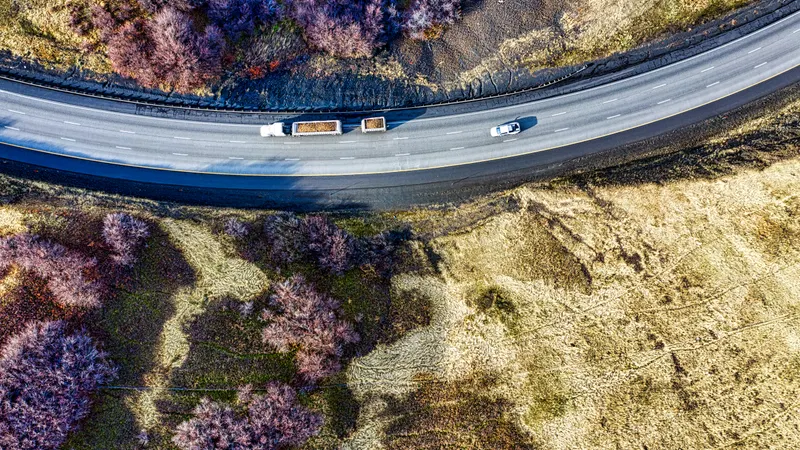
Choosing a carrier often comes down to choosing a trailer. Boxed consumer goods, frozen food, steel beams and a bulldozer all need different equipment, and the trailer affects how freight is loaded, how it is protected on the road and what the move costs. This guide describes the most common trailer types and the federal size and weight rules that apply to all of them.
Federal size and weight basics
Federal limits come from 23 CFR Part 658, which the Federal Highway Administration (FHWA) administers. The key figures are:
- Weight: on the Interstate System, the maximum gross vehicle weight is 80,000 pounds, with 20,000 pounds on a single axle and 34,000 pounds on a tandem axle, subject to the federal bridge formula (23 CFR 658.17). The 80,000 pounds covers the tractor, the trailer and the cargo together. FHWA notes that the federal government does not set weight limits for trucks on roads off the Interstate System; states do.
- Width: on the National Network of highways, no state may impose a width limit of more or less than 102 inches, with an exception that lets Hawaii keep a 108-inch maximum (23 CFR 658.15). States may issue special permits for wider loads.
- Length: no state may set a length limit of less than 48 feet for a semitrailer in a tractor-semitrailer combination on the National Network, or less than 28 feet for each trailer in a twin-trailer combination (23 CFR 658.13). States also may not impose an overall length limit on those combinations.
- Height: there is no federal height limit. FHWA reports that state standards generally range from 13.6 feet to 14.6 feet.
The 53-foot trailer is a matter of state law rather than a federal entitlement. Federal rules only guarantee 48 feet; longer semitrailers are allowed where state law or grandfathered limits permit them. FHWA's guide to federal size regulations lists the grandfathered lengths state by state and notes conditions some states attach, such as a maximum distance from the kingpin to the rear axles. FHWA's Comprehensive Truck Size and Weight Limits Study used a five-axle tractor-semitrailer with a 53-foot trailer, at 80,000 pounds, as its control vehicle, which it describes as operating on the entire Interstate System and National Network.
Enclosed trailers: dry vans and reefers
Dry van
A dry van is an enclosed, unrefrigerated box trailer. It carries general freight that needs protection from weather and theft but no temperature control: boxed goods, palletized products, paper, packaged food that is shelf stable and similar loads. Dry vans are usually loaded at a dock through rear doors with a forklift or pallet jack, so freight generally needs to be palletized or otherwise built for dock handling.
Refrigerated trailer (reefer)
FHWA's freight glossary defines a reefer as "a refrigerated trailer that is commonly used for perishable goods." A refrigeration unit at the front of the trailer holds the load at a set temperature, from chilled to frozen.
Food shipments bring extra rules. Under the FDA's sanitary transportation rule, vehicles used for food that needs temperature control for safety must be designed, maintained and equipped to provide adequate temperature control (21 CFR 1.906). A shipper of that food generally must also specify an operating temperature to the carrier in writing (21 CFR 1.908), subject to the rule's exemptions.
Open-deck trailers: flatbeds, step decks and lowboys
Flatbed
FHWA describes a flatbed as "a trailer without sides used for hauling machinery or other bulky items." Because there are no walls or roof, freight can be loaded from the sides or from above with a forklift or crane. Typical loads include lumber, steel, pipe, building materials and machinery. Drivers secure the load with straps, chains and sometimes tarps, and federal cargo securement rules require cargo to be secured so it does not shift, fall or blow off (49 CFR 393.100).
Step deck and double drop
A step deck, also called a drop deck, has a short upper deck over the tractor and a lower main deck behind it. The lower deck leaves more room for tall freight under state height limits. A double drop, or lowboy, dips even lower between the front gooseneck and the rear axles, which suits tall or heavy equipment. A removable gooseneck (RGN) version detaches at the front so machinery can be driven onto the deck.
Freight that cannot be broken down and still exceeds legal size or weight limits moves as an oversize or overweight load. Federal rules allow states to issue special permits for wider vehicles and for nondivisible loads that exceed the weight limits, so these moves need permits and planning from the state or states along the route.
Tankers and other specialized trailers
- Tank trailers carry liquids or gases such as fuel, chemicals, milk or other food-grade liquids. A driver needs a tank vehicle endorsement on a commercial driver's license to operate one, and a hazardous materials endorsement when the cargo requires it (49 CFR 383.93).
- Hopper and dry bulk trailers carry loose materials such as grain or plastic pellets, usually loaded from above and emptied from the bottom.
- Conestoga trailers are flatbeds or step decks fitted with a sliding, curtain-style cover, combining side or top loading with weather protection.
- Car haulers carry vehicles on one or two decks. Federal rules treat automobile transporters as specialized equipment with their own length provisions.
- Container chassis are frames that carry intermodal shipping containers between ports, rail yards and customers.
- Doubles are combinations of two shorter trailers pulled together. Drivers need a double/triple trailers endorsement.
Trailer comparison
| Trailer | Typical freight | How it loads | Main consideration |
|---|---|---|---|
| Dry van | Palletized and boxed general freight | Rear doors at a dock | Freight must fit through the doors and suit forklift handling |
| Reefer | Perishable food and other temperature-sensitive goods | Rear doors at a dock | Set temperature and food safety requirements |
| Flatbed | Lumber, steel, pipe, machinery | Sides or top, by forklift or crane | Securement and tarping |
| Step deck | Taller machinery and equipment | Sides, top or ramps | Height clearance under state limits |
| Lowboy or RGN | Heavy or very tall equipment | Drive-on or crane | Often needs oversize or overweight permits |
| Tank | Liquids and gases | Pumps and hoses | Driver endorsements and product compatibility |
Choosing the right trailer
A carrier can only quote the right equipment if it has the right details. Before asking for a quote, shippers can gather:
- The dimensions and weight of every piece, and whether the freight can be stacked or broken down.
- How it will be loaded and unloaded: at a dock, by forklift from the side, by crane or by driving it on.
- Any temperature range, and whether the product is food covered by FDA rules.
- Whether the material is hazardous, which affects the driver, the paperwork and the placards.
- Site limits at each end, such as low clearances, no dock or limited room for a long trailer.
With those answers, a shipper can compare quotes for the same equipment instead of discovering a mismatch on pickup day.
Sources
- eCFR: 23 CFR Part 658: Truck size and weight, route designations, length, width and weight limitations
- Federal Highway Administration: Federal Size Regulations for Commercial Motor Vehicles
- Federal Highway Administration: Chapter 1: Current Truck Size and Weight Regulations in the United States and Other Countries
- Federal Highway Administration: Freight Glossary and Acronyms
- eCFR: 21 CFR 1.908 What requirements apply to transportation operations?
- eCFR: 49 CFR 383.93 Endorsements
This guide is general information about shipping freight by truck. It is not legal advice, and rules can change, so check the official sources above for your situation. TNW Trucking is an independent freight information resource. It is not a motor carrier or freight broker and is not affiliated with any trucking company of a similar name.