Guide 5 of 9
How to package and palletize freight for a truck shipment
Freight that is stacked square, wrapped tight, labeled clearly and measured accurately is less likely to be damaged, delayed or rebilled. Here is how to get a shipment ready for the truck.
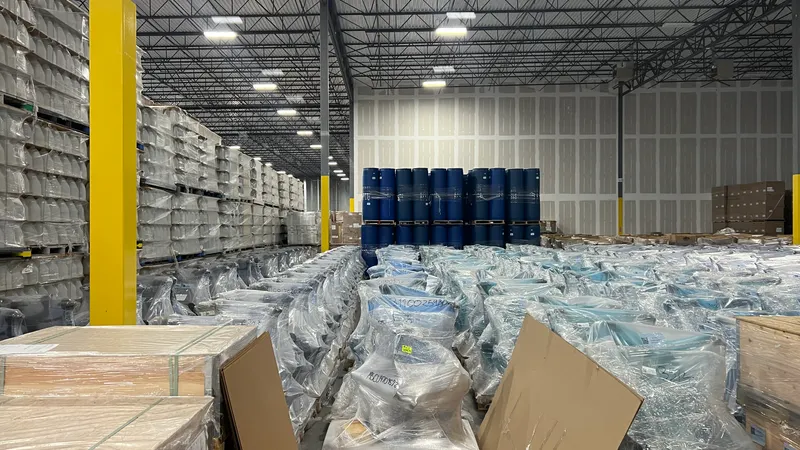
Truck freight is lifted by forklifts, loaded and unloaded, and shaken by miles of road. In less-than-truckload (LTL) service it may also be moved through terminals and loaded next to other customers' freight. Good preparation protects the goods and makes any damage claim easier to support. The steps below are general practice; your carrier's rules and any instructions it gives you come first.
Start with the right pallet
- Use a sound pallet. Skip pallets with broken or missing boards or protruding nails. A weak pallet can fail under a forklift.
- Match the pallet to the load. The freight's footprint should fit the pallet so nothing hangs over the edges. A common US pallet size is about 48 by 40 inches, but use whatever fits your product and your receiver accepts.
- Make sure it can carry the weight. Ask your pallet supplier what load a pallet is built for, especially for dense freight.
- Keep forklift openings clear so the pallet can be picked up from the intended sides.
Stack it square and stable
- Put the heaviest, strongest cartons on the bottom and lighter ones on top.
- Stack cartons squarely, edge to edge, and aim for a flat, level top so the load is stable and other freight can be placed on it if allowed.
- Avoid overhang. Cartons that hang past the pallet edge lose support and are easily crushed or snagged.
- Fill gaps inside cartons so contents cannot shift, and use corner boards or sheets between layers where they help.
- If the freight cannot have anything stacked on it, tell the carrier when you book rather than relying on a label alone.
Wrap and secure the load
Stretch wrap holds cartons together as one unit. Start at the bottom and wrap around the pallet deck so the load is tied to the pallet, not just to itself, then work up with overlapping layers and finish over the top edge. For heavy or dense loads, add banding or strapping, with edge protectors so the straps do not cut into cartons. Machinery and irregular items usually need to be crated or bolted or banded to a skid.
Inside the trailer, federal cargo securement rules apply. Under 49 CFR 393.100, cargo must be contained, immobilized or secured so it does not shift in a way that affects the vehicle's stability or maneuverability, and so it cannot leak, spill, blow or fall from the vehicle. Drivers generally must check their cargo and its securement before and during a trip. That duty does not apply to a driver of a sealed trailer who has been told not to open it, so if your crew loads and seals a trailer, the quality of the loading and bracing depends on your dock.
Label every piece
- Show the shipper's and consignee's names, full addresses and phone numbers.
- Add the bill of lading or PRO number and any purchase order number.
- Number the pieces, for example "1 of 4," so a missing piece is noticed.
- Place labels where they can be read without unwrapping, ideally on more than one side.
- Remove or cover old labels and barcodes from reused boxes and pallets.
- Make sure the piece count and description on the bill of lading match what is on the dock.
Measure and weigh accurately
LTL freight is classified under the National Motor Freight Classification (NMFC), published by the National Motor Freight Traffic Association (NMFTA), and NMFTA notes that density is one of the most important factors in both classification and pricing. For many items, class depends on density: the shipment's weight divided by its volume, in pounds per cubic foot. NMFTA warns that getting it wrong risks reclassification, back charges or delays.
Measure the length, width and height of each handling unit at its widest points, pallet included, and do not round generously. NMFTA lists common mistakes such as using old default dimensions, forgetting pallet height, and treating irregularly shaped items like standard boxes. Weigh the unit on an accurate scale, with the pallet.
Hypothetical example: a pallet measures 48 by 40 by 50 inches and weighs 600 pounds. That is 96,000 cubic inches, or about 55.6 cubic feet (divide by 1,728). The density is about 10.8 pounds per cubic foot.
The NMFC changed significantly on July 19, 2025. NMFTA replaced its 11-sub density scale with a more detailed 13-sub scale and moved more than 2,000 items to density-based classes, so a class you have used for years may no longer be right.
For full truckloads, weight limits matter too. Federal law (23 U.S.C. 127) generally caps gross vehicle weight on the Interstate System at 80,000 pounds, with limits of 20,000 pounds on a single axle and 34,000 pounds on a tandem axle, subject to exceptions. Give the carrier the true weight and spread heavy freight evenly so the truck can be loaded legally.
Hazardous materials: check before you ship
The Pipeline and Hazardous Materials Safety Administration (PHMSA) issues the Hazardous Materials Regulations, 49 CFR Parts 171 to 180. They apply to each person who offers a hazardous material for transportation, including the shipper's pre-transportation work: classifying the material, selecting packaging, marking, labeling and preparing shipping papers. No one may offer hazmat unless it is properly classed, described, packaged, marked, labeled and in condition for shipment, and employees who do this work must be trained.
Everyday products can be regulated. PHMSA's examples include aerosols such as bug spray, devices containing lithium batteries, alcohol wipes and hand sanitizer, lighters, and dry ice.
This guide does not explain how to ship hazardous materials. If anything in your shipment might qualify, follow 49 CFR Parts 171 to 180, use PHMSA's resources, and talk to the carrier before you tender it.
Sources
- NMFTA: Decoding Density: The Freight Factor You Can't Afford to Overlook
- NMFTA: How Shippers Can Prepare for the 2025 NMFC Changes
- PHMSA: Hazardous Matters July 2023
- eCFR: 49 CFR 171.2, General requirements
- eCFR: 49 CFR 393.100, Applicability and general requirements of cargo securement standards
- Legal Information Institute, Cornell Law School: 23 U.S. Code 127, Interstate System
This guide is general information about shipping freight by truck. It is not legal advice, and rules can change, so check the official sources above for your situation. TNW Trucking is an independent freight information resource. It is not a motor carrier or freight broker and is not affiliated with any trucking company of a similar name.